
Investing used to feel like a game for people with thousands of dollars to spare. That’s no longer true. Today, $100 is enough to start building a real portfolio — the tools have simply changed.
Can You Really Start Investing with Just $100?
Yes. Modern brokerages let you buy fractional shares of stocks and ETFs, meaning you don’t need $3,000 to own a slice of a company like Amazon or a broad index fund. Apps like Fidelity, Schwab, and various fintech platforms let you invest as little as $1, splitting a single share into tiny pieces so your $100 can be spread across multiple companies or funds instead of sitting idle waiting to afford one whole share.
1. Build an Emergency Fund First
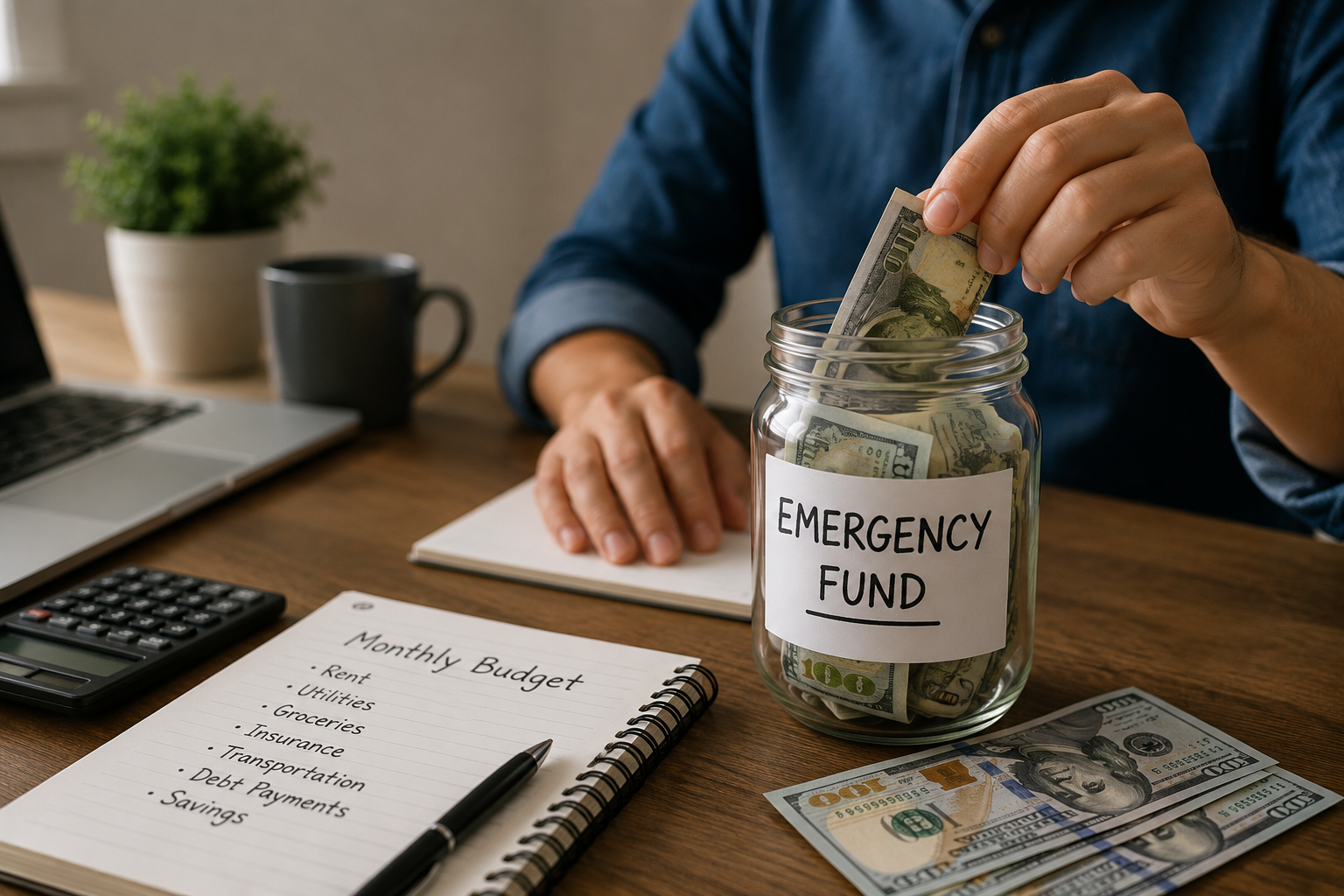
Before your $100 goes anywhere near the market, make sure you have a cushion for the unexpected — a car repair, a medical bill, a sudden job loss. Without that buffer, an emergency can force you to sell investments at the worst possible time, locking in losses just when the market dips. Most financial guidance suggests aiming for three to six months of essential expenses in an accessible account before investing aggressively. If $100 is genuinely all you have, it may make more sense as the seed of that fund rather than your first stock purchase — the two goals aren’t in competition, just sequenced.
2. Invest in an S&P 500 ETF
For beginners, low-cost ETFs (exchange-traded funds) that track the S&P 500 are one of the most popular starting points. A single share gives you exposure to 500 of the largest U.S. companies at once, instantly diversifying your money instead of betting on one stock. These funds typically carry very low expense ratios (often under 0.10% annually), and historically the S&P 500 has returned around 10% per year on average before inflation, though any given year can swing widely in either direction. With fractional shares, $100 is plenty to get started.
3. Consider High-Yield Savings Accounts
If your priority is safety and liquidity rather than growth, a high-yield savings account (HYSA) is worth considering instead of or alongside investing. These accounts, often offered by online banks, pay meaningfully more interest than a traditional savings account and are typically FDIC-insured up to $250,000. Your money isn’t exposed to market swings, and you can withdraw it anytime — a good home for money you might need soon, or for the emergency fund mentioned above.
4. Buy Fractional Shares
Fractional shares let you own a piece of expensive companies — Apple, Microsoft, Amazon — without needing the full share price upfront. If Apple trades at several hundred dollars a share, $100 can still buy you a proportional slice of it, and your gains or losses scale with that fraction. This is especially useful for beginners who want to own recognizable, established companies rather than starting only with funds.
5. Keep Investing Every Month
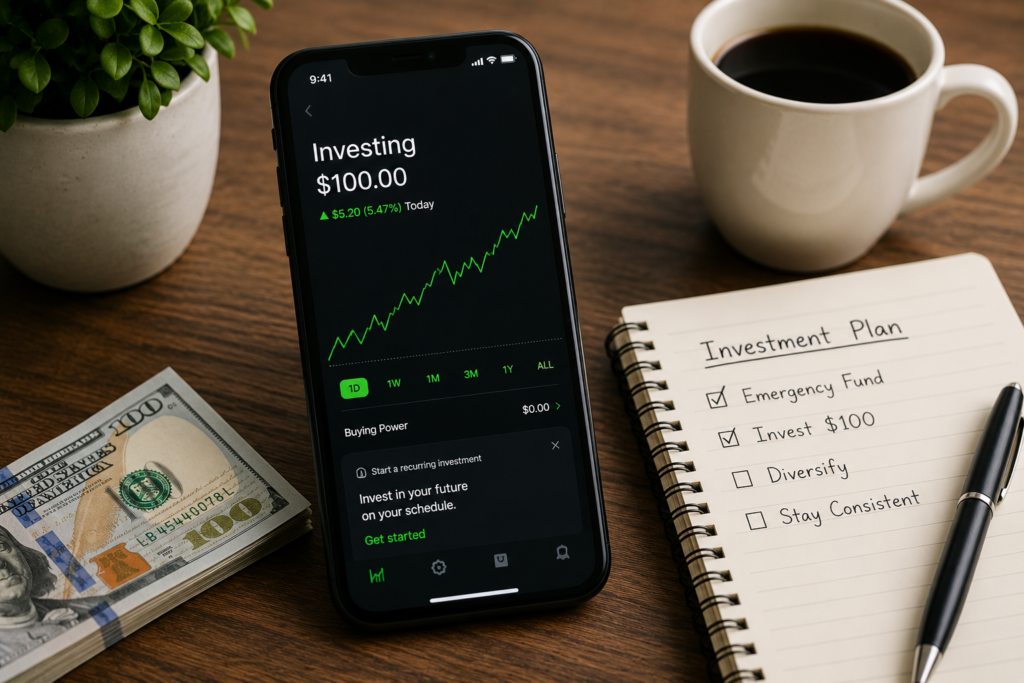
A single $100 investment is a start, but consistency is what builds real wealth. Investing $100 every month — a strategy known as dollar-cost averaging — smooths out the ups and downs of the market, since you buy more shares when prices are low and fewer when prices are high. Over 20 or 30 years, with compounding returns, monthly contributions of $100 can grow into a substantial sum, far more than the sum of contributions alone. Time in the market, not timing the market, tends to matter most.
Common Mistakes to Avoid
- Trying to get rich quickly — chasing meme stocks or speculative trades often leads to losses; sustainable investing is a long game.
- Investing without research — understand what you’re buying, even if it’s just knowing what an ETF tracks.
- Ignoring fees — small percentage fees compound over decades and can quietly erode returns.
- Not diversifying — putting all $100 into one stock is riskier than spreading it across a fund or a few holdings.
Frequently Asked Questions
- Is $100 enough to start investing?
- Yes. Thanks to fractional shares and no-minimum brokerage accounts,
- $100 can buy a diversified starting position in ETFs or individual stocks.
- What’s the safest investment for beginners?
- Broadly, government bonds and high-yield savings accounts carry the least risk, while diversified ETFs carry more risk but higher long-term growth potential. “Safest” depends on your goals and timeline.
- Can I make money investing only $100?
- You can grow it over time, especially with regular monthly contributions, but a single $100 investment alone is unlikely to generate life-changing returns quickly. It’s a starting point, not a windfall.
- How long does it take to grow $100?
- It depends entirely on the rate of return and whether you keep adding to it. Left alone at historical average market returns, it would take years to meaningfully grow; paired with monthly contributions, growth accelerates significantly.
Conclusion
You don’t need thousands of dollars or expert knowledge to start investing — you need $100, a bit of patience, and a plan. Start with an emergency cushion, choose low-cost diversified funds or fractional shares, and keep contributing consistently. The habit matters more than the initial amount.This article is for informational purposes only and isn’t financial advice. Consider consulting a licensed financial advisor for guidance tailored to your situation.