
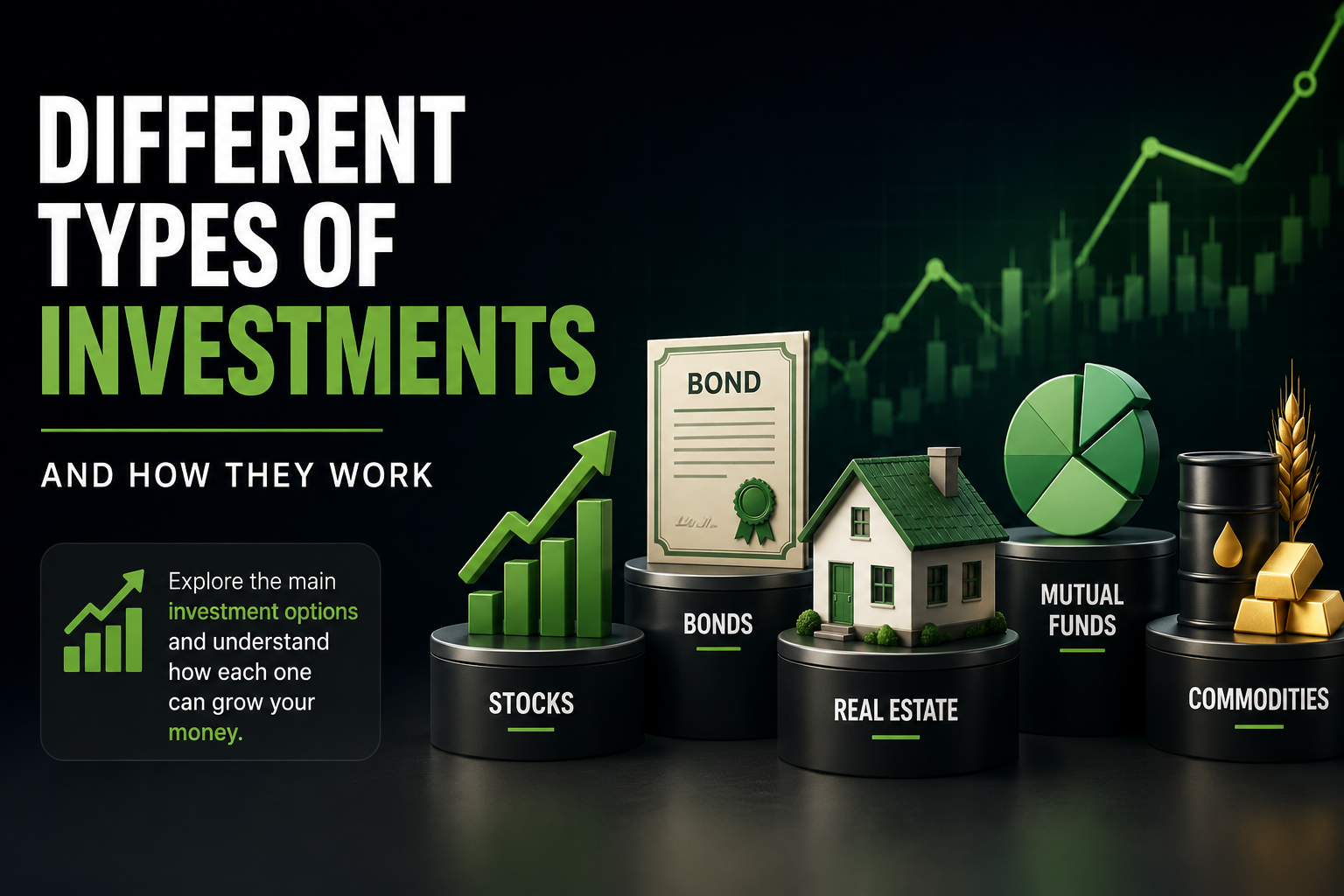
Building wealth starts with understanding where you can put your money to work. From stocks to real estate to cryptocurrency, each asset class comes with its own risk, reward, and role in a portfolio. Here’s a clear, beginner-friendly breakdown of the major investment types available today.
1. Stocks (Equities)
A stock represents a share of ownership in a company. When you buy shares, you become a partial owner and benefit from the company’s growth and profits. Investors make money in two main ways: capital appreciation (the stock price rising over time) and dividends (a portion of profits paid out to shareholders). Stocks offer strong long-term growth potential, but they come with volatility — prices can swing sharply based on company performance, economic conditions, and market sentiment.
2. Exchange-Traded Funds (ETFs)
ETFs are baskets of securities, such as stocks or bonds, that trade on an exchange just like an individual stock. Many ETFs track an index, like the S&P 500, giving investors instant exposure to hundreds of companies in a single purchase. This built-in diversification makes ETFs a popular, low-cost way to reduce risk compared to picking individual stocks.
3. Bonds (Fixed Income Securities)
Bonds are essentially loans investors make to governments or corporations in exchange for regular interest payments and the return of principal at maturity. Government bonds are generally considered safer, while corporate bonds offer higher yields with more risk. Bonds play a key role in a portfolio by providing steady income and helping balance out the volatility of stocks.
4. Real Estate Investments
Real estate can be owned directly, through rental properties that generate income and appreciate over time, or indirectly through Real Estate Investment Trusts (REITs) — companies that own and manage income-producing properties and trade like stocks. Direct ownership offers control and potential tax benefits but requires capital and hands-on management, while REITs offer liquidity and diversification with a much lower barrier to entry.
5. Mutual Funds
Mutual funds pool money from many investors to buy a diversified mix of assets, managed by a professional fund manager. Actively managed funds aim to outperform the market through strategic picks, while passively managed funds simply track an index at a lower cost. Fees matter here — expense ratios can significantly eat into long-term returns, so it pays to compare costs carefully.
6. Cryptocurrencies
Cryptocurrencies are digital assets built on blockchain technology, a decentralized ledger system that removes the need for a central authority like a bank. Bitcoin and Ethereum are the most well-known examples. Crypto markets are known for extreme volatility and speculative risk, making them a high-risk, high-reward category best suited for investors who can tolerate significant price swings.
7. Commodities
Commodities are raw materials or primary agricultural products, such as gold, silver, oil, and natural gas. Precious metals are often used as a hedge against inflation and economic uncertainty, while energy commodities track global supply and demand. Adding commodities to a portfolio can improve diversification since they often move independently of stocks and bonds.
8. Alternative Investments
Alternative investments sit outside traditional stocks and bonds. This category includes private equity (investing directly in private companies), hedge funds (pooled funds using advanced strategies), venture capital (funding early-stage startups), and collectibles like art or wine. These investments often require more capital, carry higher risk, and are less liquid, but they can offer unique growth opportunities and further diversification.
9. Cash and Cash Equivalents
Cash and cash equivalents — savings accounts, money market funds, and similar low-risk holdings — prioritize safety and liquidity over growth. While returns are modest, this category is essential for short-term financial goals and emergency funds, giving investors quick access to money without market risk.
10. How Investors Choose Between Different Investments
Choosing the right mix of investments depends on a few key factors: risk tolerance (how much volatility you can handle), investment objectives (growth, income, or preservation), time horizon (how long until you need the money), and the goal of overall portfolio diversification. Combining asset classes that behave differently under various market conditions helps smooth out returns and manage risk.
Conclusion
Every asset class — from stocks and bonds to real estate, crypto, and cash — plays a distinct role in a well-rounded investment strategy. Understanding how each one works, and how they fit together, is the foundation for building a balanced portfolio that matches your goals, timeline, and comfort with risk. The key isn’t picking the “best” investment, but building the right combination for your financial journey.